
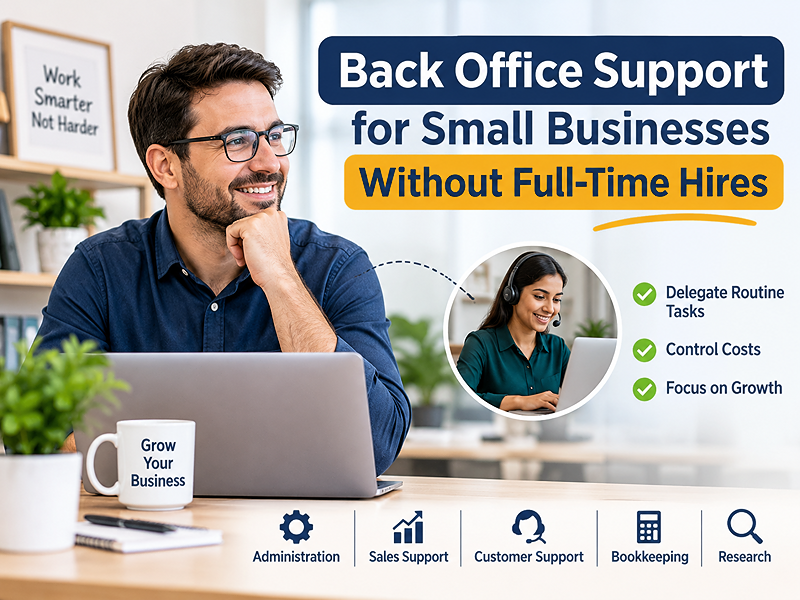
Running a small business means wearing many hats. Sales, customer relationships, operations, finances, hiring, marketing, and day-to-day administration often land on the same desk. As the company grows, the workload grows with it, but not every new task justifies hiring another full-time employee.
This is where back office support can make a real difference. By combining a small core team with virtual assistants and other flexible resources, businesses can get the help they need without building a large permanent staff.
Why Back Office Support Matters for Small Businesses
Back office support is the behind-the-scenes work that keeps a business organized, from data entry and CRM updates to scheduling, reporting, bookkeeping, and email management. Customers rarely see it, but they feel it when it is missing.
When this work slips, the effects add up quickly: leads go unanswered, records fall out of date, invoices are delayed, and reports arrive late. When the owner handles it all personally, several hours every week go to administration instead of sales, customers, strategy, and growth.
Strong back office support protects that time. It keeps daily operations steady so the people who drive revenue can stay focused on it.
Why Hiring Full-Time Isn't Always the Answer
A full-time hire makes sense when the workload consistently needs a dedicated person. The problem is that businesses sometimes hire too early, assuming every recurring task requires a full-time position.
Consider a company that needs help with:
That adds up to 25 hours a week, which is not necessarily a full-time role. A flexible back office support model lets the business delegate those tasks without creating a position it may not fully need.
Build Around Tasks, Not Job Titles
The most effective way to create a flexible team is to start with tasks rather than positions. Instead of asking, “Do we need to hire an administrative assistant?”, ask, “Which administrative tasks are taking the most time from our existing team?”
Once you know the answer, the structure becomes clearer:
Sales team – Focuses on sales conversations and closing opportunities.
Virtual assistant (VA) – Handles prospect research, lead lists, follow-ups, CRM updates, and scheduling.
Business owner – Focuses on strategy and key customer relationships.
Virtual assistant (VA) – Handles recurring administrative work, reporting, documentation, and coordination.
This creates a team structure based on actual workload instead of assumptions.
Identify Your Most Time-Consuming Tasks
Before outsourcing anything, list the recurring tasks your team handles each week. Look for activities that are:
Common examples include updating customer records, researching prospects, sending follow-up emails, preparing reports, managing spreadsheets, scheduling appointments, entering invoices, and organizing documents. These are often strong candidates for delegation.
Keep, Delegate, or Automate
Not every task should be handed off. A simple way to decide is to sort work into three categories.
Keep
Tasks that need your expertise, judgment, relationships, or strategic thinking, such as business strategy, major negotiations, key customer relationships, final hiring decisions, and complex financial decisions.
Delegate
Tasks that are important but follow established processes, such as data entry, CRM updates, lead research, follow-ups, scheduling, reporting, and document organization.
Automate
Tasks that software can handle efficiently, such as appointment reminders, basic notifications, recurring reports, data synchronization, and standard email confirmations.
The goal isn’t to outsource as much as possible. It is to make sure every task is handled by the most appropriate resource.
How a Virtual Assistant Fits Into Your Back Office Support
A virtual assistant can become a natural extension of your existing team. Depending on your needs, a VA can support several areas:
The exact responsibilities can be adjusted to suit your business.
Don't Outsource Everything at Once
A common mistake is delegating too much, too quickly. A phased approach works better:
This gives your team time to establish processes and learn what works before adding more responsibilities.
Create Simple SOPs
A flexible team still needs clear processes. Standard operating procedures (SOPs) help a VA understand exactly how a task should be completed. They don’t need to be complicated. A good SOP covers:
For example, for following up with prospects who received a quote: check the CRM, review previous communication, send the approved follow-up, record the response, schedule the next action, and escalate interested prospects. Simple processes like this make delegation easier and more consistent.
Use Your Existing Tools
You don’t need to overhaul your technology to bring in back office support. A VA can usually work inside the systems you already use, such as your CRM, email, Google Workspace, Microsoft Office, project management tools, accounting software, and scheduling tools. What matters is establishing clear access, responsibilities, and processes.
Keep Communication Structured
Flexible staffing works best when communication has a clear structure. Define who assigns tasks, where tasks are submitted, how priorities are shared, when updates are provided, which issues need escalation, and how completed work is reviewed.
A simple weekly rhythm can be enough:
This builds accountability without constant supervision.
Measure the Results
Good back office support should create measurable value. Depending on the tasks delegated, you can track:
The purpose isn’t simply to measure the VA. It is to understand whether the outsourced work is genuinely improving your capacity and efficiency.
When Should You Consider Flexible Back Office Support?
You may benefit if:
These situations don’t always mean you need more permanent employees. They may simply mean you need additional capacity.
A Flexible Team Grows With Your Business
One of the biggest advantages of this model is that it adapts. When demand increases, you delegate more tasks. When demand slows, you scale support back. When you launch a new service or department, you add help in that area. Instead of carrying the same staffing level regardless of workload, you adjust support based on what is actually happening in the business.
How Khened VA Can Support Your Back Office
Khened VA provides flexible virtual assistant services for businesses that need administrative, operational, sales, customer support, bookkeeping, research, and marketing assistance. Our VAs work alongside your existing team and take responsibility for recurring tasks that don’t require a full-time internal employee.
Whether you need a few hours of support each week or extra help during a busy period, the goal is to increase your team’s capacity so you and your employees can focus on higher-value work.
Final Thoughts
Building a strong team doesn’t always mean hiring more full-time employees. For many small businesses, a better approach is to identify the tasks consuming the most time, decide which responsibilities can be delegated, and build a flexible structure of back office support around those needs.
The result is a leaner team that adapts as workload and priorities change. The key is simple: don’t build your team around how many employees you think you need. Build it around the work that actually needs to get done.
Looking for reliable back office support? Contact us today to see how our virtual assistant services can help your business grow.