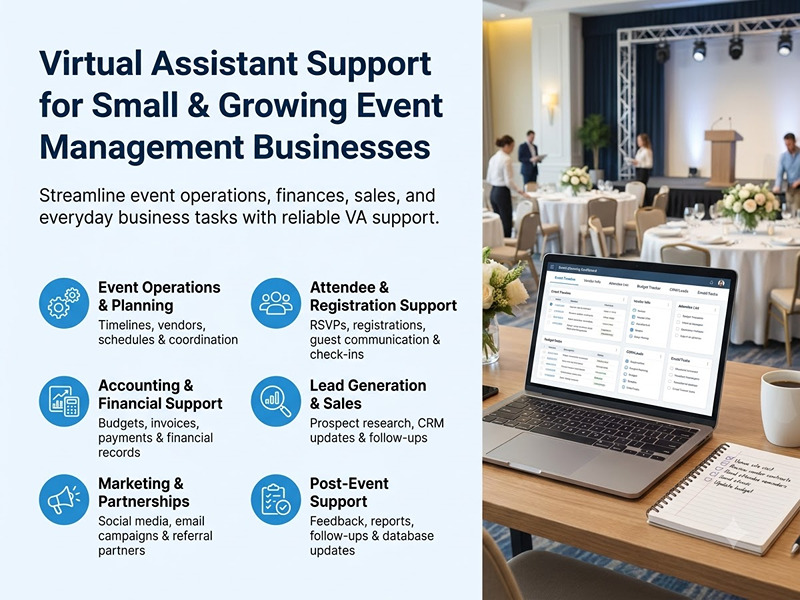
Behind every successful event is a long list of tasks that need to be managed. For small and growing event management businesses, handling day-to-day operations while keeping up with sales, business development, client communication, and administrative work can quickly become overwhelming.
That’s where a virtual assistant (VA) can help. By taking care of routine operational and administrative tasks and supporting sales and business development activities, a VA gives event management businesses more time to focus on their clients, deliver memorable events, and grow their business.
How a Virtual Assistant Can Support Your Event Management Businesses
As event businesses grow, so does the amount of work involved in managing each event and running the business. Small and emerging teams often need to manage multiple responsibilities at once.
A Virtual Assistant (VA) can support different areas of the business, helping handle the growing workload while allowing the event team to focus on delivering great events and building the business.
1. Operational and Administration Support
Operational support covers the day-to-day work involved in planning, coordinating, and delivering events.
Venue & Vendor Management
Find and coordinate venues and suppliers that match the client’s capacity, location, style, and budget.
How a VA can help:
Event Design & Production Support
Manage themes, decor, staging, lighting, sound, branding, and the overall guest experience, including webinars, online summits, and hybrid conferences.
How a VA can help:
Travel, Accommodation & Transportation
Coordinate travel and accommodation for speakers, VIPs, staff, and guests, including ground transportation for conferences, incentive trips, and destination events.
How a VA can help:
Event Planning and Project Coordination
Coordinating multiple workstreams, deadlines, suppliers, client approvals, and team members to keep an event moving from initial brief to event day.
How a virtual assistant (VA) can help:
Speakers, Talent, Sponsors & Exhibitors
Coordinate keynote speakers, panelists, performers, and MCs, while managing sponsors and exhibitors.
How a VA can help
Registration, Ticketing & Attendee Management
Manage invitations, registrations, ticket sales, and attendee communication.
How a VA can help:
Event Operations, Staffing & Event-Day Support
Manage permits, licenses, insurance, safety documentation, temporary staffing, volunteers, and event-day operations.
How a VA can help:
Post-Event & Back-Office Administration
Close out events, review results, maintain client relationships, and manage the day-to-day business.
How a VA can help:
Administrative Support
A VA can also provide ongoing administrative support across the event management businesses, including:
Temporary Staffing Support for Catering & Events
For catering businesses, event planners that regularly need temporary staff, a VA can help organize and support the staffing process before an event.
A VA can assist with:
The event or catering manager remains responsible for final hiring decisions, staff supervision, work assignments, and on-site management.
2. Accounting & Financial Support
Administrative and financial work continues before, during, and after every event. A VA can help keep information, documents, finances, and day-to-day business activities organized.
Event Budgeting & Financial Management
Build client budgets, manage event spending and vendor payments, and handle the company’s own invoicing and cash flow.
How a virtual assistant (VA) can help:
Financial Reporting & Business Performance Tracking
Small and growing businesses can benefit from having financial information organized into simple reports that make it easier to monitor business performance and make informed decisions.
How a VA can help:
Financial Document & Record Organization
As an event business grows, the number of invoices, receipts, contracts, payment records, and other financial documents can quickly increase. A VA can help keep these records organized, secure, and easy to retrieve.
How a VA can help:
3. Sales & Business Development Support
Along with operational and administrative support, virtual assistant (VA) also provide sales and business development support. Beyond individual events, an event management business needs a consistent flow of new clients, partnerships, sponsors, and opportunities to support continued growth.
Lead Generation
Build a pipeline of new clients, including corporate accounts, wedding clients, festival partners, and other potential customers through prospecting, enquiries, RFP responses, consultations, and proposals.
How a VA can help:
Pricing and negotiations remain with the event manager.
Referral Partnerships & Business Networking
Build relationships with complementary businesses and professionals that can refer potential clients, event opportunities, and new business.
Referral partnerships can be particularly valuable for small and growing event management businesses. Instead of relying only on direct prospecting, businesses can develop relationships with venues, caterers, photographers, hotels, travel companies, corporate service providers, wedding professionals, entertainment providers, and other businesses that regularly interact with potential event clients.
How a VA can help:
Marketing, PR & Social Media Support
Promote upcoming events to increase registrations while marketing the event business to attract future clients.
How a VA can help:
The marketing lead retains control of brand voice and final approvals.
Benefits of Hiring a Virtual Assistant for Event Management Businesses
A virtual assistant is not just an extra pair of hands. For small and growing businesses, the right virtual assistant (VA) can make day-to-day operations more flexible, efficient, and easier to manage.
1. More Flexibility
Businesses can adjust the amount of support they need as priorities change. This is especially useful when workload increases during busy periods or new projects.
2. Faster Business Operations
Having reliable support available can help keep things moving instead of letting smaller responsibilities pile up. This can make everyday business operations more consistent.
3. Access to a Wider Talent Pool
Businesses are not limited to people who live nearby. Remote hiring opens the door to professionals with different skills, experience, and working backgrounds.
4. Save Time
A VA can take on responsibilities that would otherwise compete for the business owner’s attention. This creates more time for planning, decision-making, customer relationships, and other activities that have a direct impact on growth.
5. Reduce Business Costs
Hiring a virtual assistant (VA) can help businesses avoid some of the costs associated with a traditional full-time role. Depending on the arrangement, businesses can pay for the support they actually need rather than maintaining a full-time position.
6. Focus on What Matters
With everyday tasks handled by a virtual assistant (VA), business owners/event managers can spend more time on strategy, decision-making, customers, and other activities that move the business forward.
Conclusion
For modern event management businesses, having the right Virtual Assistant is becoming an essential part of building an efficient and scalable operation. A VA is not simply someone who completes a list of assigned tasks. The right VA can understand the bigger picture, anticipate needs, identify opportunities to improve processes, and provide strategic and consultative support when required.
They can also combine human expertise with technology to work more efficiently. Where AI tools and automation can save time, a VA can use them to streamline processes, organize information, support research, and reduce repetitive work. When a task requires human judgment, attention to detail, creativity, or personal communication, the VA can step in and handle it manually.
This combination of human judgment, strategic thinking, technology, and reliable execution allows event businesses to operate more efficiently while giving managers more time to focus on clients, relationships, creativity, and growth.
Ready to build a smarter and more efficient event operation? Schedule a free consultation with Khened VA Services & Consulting today to discover how a dedicated VA can support your business, streamline your operations, and contribute to your long-term growth.