
Seasonal workloads can quickly change what businesses need to keep operations running smoothly. During busy periods, customer inquiries increase, sales follow-ups pile up, and administrative work can take valuable time away from the core team.
Hiring additional help can solve these challenges, but not every business needs another full-time employee year-round. So, what do businesses need for seasonal work, a virtual assistant or a temporary employee?
In this guide, you’ll learn the difference between a virtual assistant and a temporary employee, when each option makes sense, which seasonal tasks can be outsourced, and how to choose the right staffing solution for changing workloads.
What Is Seasonal Staffing?
Seasonal staffing means hiring additional workers when business activity increases for a limited period.
Depending on the industry, businesses need extra support during:
Since this workload may last only weeks or months, hiring a permanent employee for a temporary increase in workload may not make financial or operational sense, That is why many businesses consider flexible staffing a practical alternative.
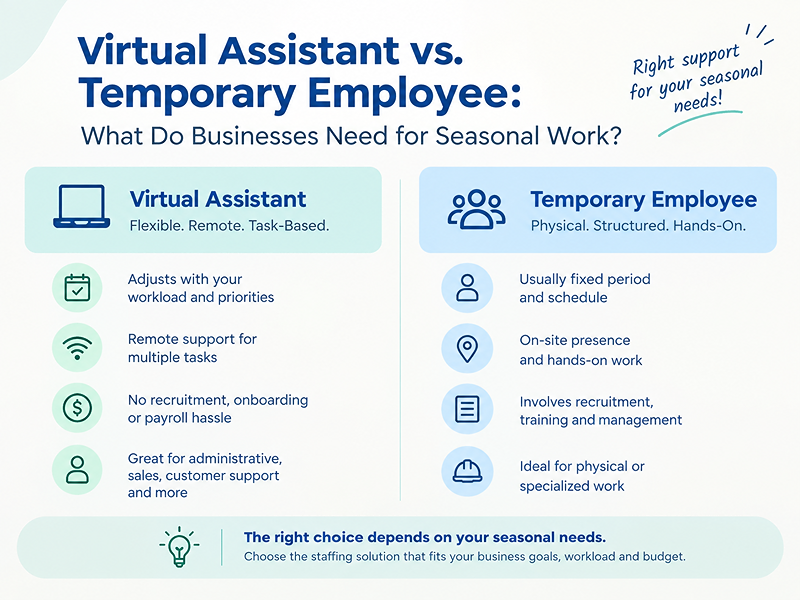
Virtual Assistant vs. Temporary Employee: What Do Businesses Need?
| Factor | Temporary Employee | Virtual Assistant |
|---|---|---|
| Flexibility | Usually fixed period and schedule | Can adjust with workload |
| Work Structure | Traditional employment | Remote, task-based support |
| Best For | Physical or hands-on work | Remote administrative and support tasks |
There is no single staffing solution that works for every company. Understanding what businesses need during their busiest periods can make the decision much easier.
Flexibility
A temporary employee usually works for a defined period and predetermined schedule. A VA can provide support based on changing workloads and priorities.
For example, businesses may need more support during a busy week and less after the seasonal peak. This type of flexible staffing can be valuable when seasonal demand is difficult to predict.
Administrative Workload
Temporary hiring can involve recruitment, onboarding, payroll, scheduling, and employee management. With a VA service, many of these responsibilities are handled by the service provider, allowing businesses to focus on assigning tasks and reviewing results.
Type of Support
Temporary employees are often hired for a specific role, while a VA can support multiple functions depending on their skills, including sales, customer support, administration, and operations.
This makes virtual assistance particularly useful for businesses that need additional capacity across different tasks without creating a new full-time role.
When Does a Virtual Assistant Make More Sense?
A VA may be a better fit when businesses need:
For example, a business may experience a significant increase in customer inquiries during its peak season without needing another employee year-round. A VA can support follow-ups, scheduling, customer communication, CRM updates, and administrative work during that period.
Common Seasonal Tasks You Can Outsource to a Virtual Assistant
Many repetitive and time-consuming tasks can be delegated during busy periods.
Lead Generation and Sales Support
Customer Support
Administrative Support
Operations and Bookkeeping Support
Depending on expertise and requirements, a VA can also assist with:
Delegating these recurring tasks can help internal teams focus on higher-value responsibilities during busy seasons.
These are just some of the ways a virtual assistant can support your business. Other services can also be tailored to your specific business requirements, workload, and priorities.
How to Decide Between a VA and a Temporary Employee
Before choosing a staffing solution, consider what businesses need based on the type of seasonal work.
Need physical presence or hands-on work?
A temporary employee may be the better option.
Need remote, task-based support?
A virtual assistant may be a stronger fit.
Is the workload unpredictable?
Flexible VA support can make it easier to adjust as demand changes.
Do you only need help with specific tasks?
A VA can provide additional capacity without creating an entire full-time role.
The key is to identify the tasks creating the biggest workload and choose the staffing model that best fits those needs.
If you’re comparing different hiring options, learn more about which hire is right for your business.
How Khened VA Can Support Seasonal Business Needs
At Khened VA, we provide flexible virtual assistant support based on your business’s workload, priorities, and recurring tasks.
Our VAs can assist with administrative support, operations, customer service, sales support, lead generation, bookkeeping, research, CRM management, and other recurring responsibilities.
If your business experiences a seasonal increase in workload, you can delegate specific tasks instead of adding another full-time position. This gives your team additional capacity while allowing employees to stay focused on higher-value responsibilities.
Final Thoughts: What Do Businesses Need During Seasonal Peaks?
Seasonal demand does not always mean businesses need to hire a permanent employee. The right choice depends on whether you need physical, dedicated support or flexible, remote, task-based assistance.
For businesses that need seasonal business support, a virtual assistant can help with lead follow-ups, customer support, administrative work, research, CRM management, and other recurring tasks.
If your team is spending too much time on repetitive work during busy seasons, Khened VA Services can help. Contact us today to discuss your seasonal workload and see how flexible virtual assistant support can give your team the extra capacity it needs, without adding another full-time position.