
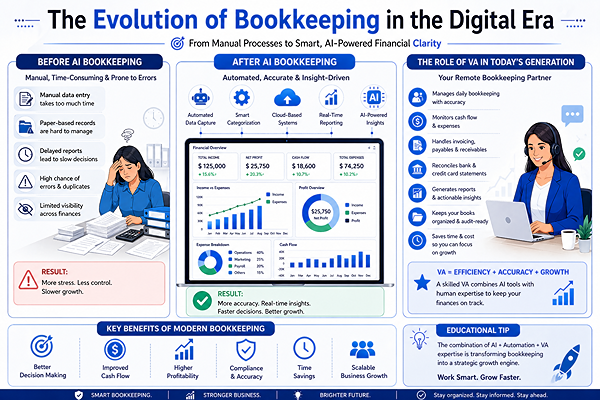
In every successful business, there is one quiet system working behind the scenes that keeps everything stable, compliant, and growth-ready. That system is bookkeeping.
What was once a slow, manual process has now transformed into a dynamic, technology-driven function that directly influences business decisions. Today, bookkeeping is not just about recording transactions. It is about creating financial clarity, enabling strategy, and supporting scalability.
This article takes you from the fundamentals of bookkeeping to its modern evolution, while also showing how Virtual Assistants can play a critical role in managing it efficiently.
Understanding Bookkeeping: The Foundation of Financial Health
Bookkeeping is the systematic recording and organization of all financial transactions within a business.
These transactions typically include:
At its simplest level, bookkeeping answers one essential question:
Where is the money coming from, and where is it going?
Why Bookkeeping is More Important Than Ever
Many small businesses underestimate bookkeeping until they face financial confusion. In reality, it is one of the most important functions in any organization.
Key Benefits
Business owners can instantly understand profits, losses, and cash flow
Data-backed insights replace guesswork
Organized records reduce stress during tax season
Helps avoid overspending and late payments
Clean financial records build trust with investors and lenders
Real-world Example
Imagine a small digital marketing agency that notices declining profits despite increasing clients. Through proper bookkeeping, they discover that software subscriptions and ad spend have quietly increased. With this insight, they restructure their pricing and restore profitability.
Traditional Bookkeeping vs Modern Bookkeeping
How It Was Done Earlier
A few years ago, bookkeeping looked very different:
This approach was time-consuming and reactive.
| Also read: Outsourced Accounting vs In-hsouse: Choosing What’s Right
How It Works Today
Modern bookkeeping has become faster, smarter, and more reliable with tools like QuickBooks.
This shift has transformed bookkeeping into a proactive system that supports business growth.
Types of Bookkeeping Methods and Systems
Understanding bookkeeping systems helps businesses choose the right approach.
1. Single Entry System
2. Double Entry System
3. Cash-Based Bookkeeping
4. Accrual-Based Bookkeeping
Quick Comparison
How Bookkeeping is Evolving Today
The digital transformation has reshaped bookkeeping in several important ways.
1. Automation and Efficiency
Repetitive tasks such as data entry are now automated:
2. Cloud-Based Systems
With Cloud Computing:
3. Intelligent Insights
Thanks to Artificial Intelligence:
4. Integrated Ecosystems
Modern tools integrate seamlessly with:
This eliminates duplication and reduces errors.
Tools and Strategies in Modern Bookkeeping
Commonly Used Tools
Effective Strategies
How Bookkeeping Should Be Performed
Consistency and discipline are key.
Ideal Workflow
Daily Tasks
Weekly Tasks
Monthly Tasks
Quarterly Tasks
Example
A small online store uses QuickBooks to record and categorize all daily transactions, such as sales and expenses. Each week, the owner reviews pending payments (e.g., accounts receivable) and reconciles the store’s bank account to ensure accuracy. At the end of the month, they review financial reports like the income statement and balance sheet, analyze profit margins, and adjust product pricing or business strategies based on the data.
How Virtual Assistants Add Value in Bookkeeping
A Virtual Assistant is not just a support role anymore. In bookkeeping, a skilled VA becomes a financial operations partner.
Today’s bookkeeping is more efficient and streamlined through AI systems.
Yes, bookkeeping has evolved. There is no doubt about it. With the adoption of automation, AI integration, and systems running in autopilot mode, bookkeeping has become faster and more efficient. However, there are still important areas where AI cannot replace human involvement. In certain situations, human intervention is essential, such as:
- Professional Judgment in Complex Transactions:
AI can categorize routine entries, but complex, non-standard, or judgment-based transactions require human understanding of business context and intent. - Interpreting Incomplete or Unclear Data:
When financial records are missing or inconsistent, AI may make incorrect assumptions, making human review necessary. - Regulatory Understanding and Compliance:
Accounting standards and tax regulations change frequently. Ensuring correct interpretation and application requires up-to-date human expertise. - Ethical Oversight and Decision-Making:
Situations involving ethical considerations (e.g., aggressive accounting practices) need human responsibility and accountability. - Adapting to Unique Business Needs:
Every business has specific workflows and exceptions. Human involvement ensures processes are tailored beyond standard automation. - Strategic Planning and Financial Thinking:
Budgeting, forecasting, and scenario planning require critical thinking that AI cannot fully replicate. - Audit Trail Review and Validation:
Human intervention is required to review AI outputs to verify accuracy, correct errors, and ensure reliable financial records. - Client Interaction and Financial Guidance:
Discussing reports, answering questions, and providing meaningful insights require clear human communication and expertise. - Empathy and Emotional Intelligence:
During challenging business situations, clients need reassurance and support that only a human can provide.
AI is a powerful tool that improves efficiency, but it works best as a support system. Human expertise remains essential for accuracy, judgment, and trust in bookkeeping.
From a modern perspective, bookkeeping in an AI-driven automation environment has become highly efficient and streamlined. You no longer need to worry about managing everything manually because a skilled Virtual Assistant Bookkeeper can combine the best of both worlds.
They use AI integration and set autopilot modes where tasks can be automated. At the same time, they identify areas that require human intervention and handle tasks that need a human touch. This ensures a Virtual Assistant manages each part effectively by applying automation where suitable and human expertise where necessary.
This balanced approach ensures that technology handles repetitive and time-consuming tasks, while human intervention is used for complex decisions, error checking, and client-specific requirements. A Virtual Assistant bridges this gap effectively by knowing when to rely on automation and when to step in with professional oversight.
As a result, your bookkeeping becomes more accurate, efficient, and cost-effective, allowing you to focus on growing your business instead of getting stuck in financial processes.
How a VA Keeps Bookkeeping Organized
Organization is where a VA creates real impact.
Structured Approach
Example
A VA manages bookkeeping for a consulting firm by:
This ensures that the business is always audit-ready.
How a VA Manages Bookkeeping for Small Businesses
Small businesses often struggle with time and expertise. A VA simplifies the entire process.
Step-by-Step Process
1. Setup and Organization
2. Daily Financial Tracking
3. Regular Monitoring
4.Growth Support
Financial forecasting
Final Summary
Bookkeeping has evolved from a manual, time-consuming task into a powerful business function driven by technology and insight.
For businesses, it provides clarity and control.
For Virtual Assistants, it creates a high-demand opportunity to deliver real, measurable impact.
By combining the right tools, structured processes, and modern strategies, bookkeeping becomes more than a support task. It becomes a core driver of smarter decisions and sustainable growth.
In a world where data shapes every move, well-managed bookkeeping is not optional. It is essential.
If you are looking to streamline your finances, stay organized, and make confident business decisions, Khened VA Services & Consulting is here to support you. From day-to-day bookkeeping to complete financial organization using tools like QuickBooks, we help you focus on growing your business while we take care of the numbers.
Get in touch today and take the first step toward stress-free, structured bookkeeping.