A few years ago, a small business owner trying to grow their B2B services would spend hours cold calling, manually sending emails, and tracking leads in spreadsheets. Despite hard work, results were inconsistent. Some weeks brought replies, most weeks brought silence.
Today, the same business can run a structured sales system where AI finds leads, automation nurtures them, and a Virtual Assistant ensures everything runs smoothly. The owner now focuses only on meaningful conversations and closing deals.
This is not the future anymore. This is how modern B2B sales works today.
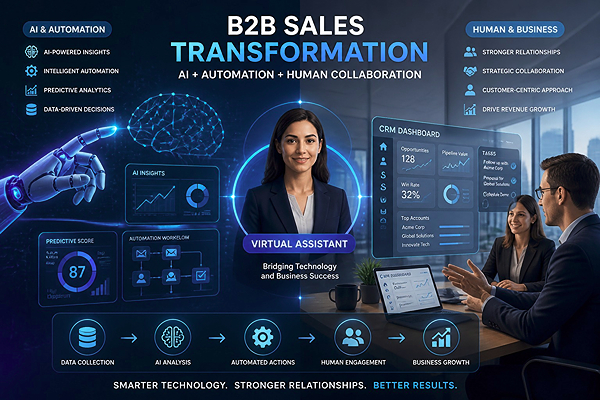
B2B sales is no longer just about selling. It is about systems, data, automation, and human intelligence working together.
Understanding B2B Sales in Simple Terms
B2B sales means Business to Business sales, where one company sells products or services to another company.
Unlike B2C (Business to Consumer), B2B sales is:
Example:
A software company selling CRM software to another company is B2B sales.
Why Sales is the Heart of Every Business
Sales is not just a department. It is the engine of survival.
Without sales:
Without sales:
At its core, sales is not about pushing products. It is about solving problems and building trust.
Traditional B2B Sales: How It Used to Work
Earlier B2B sales was heavily manual and dependent on human effort alone.
Typical methods included:
Challenges:
Success depended more on effort than systems.
Modern B2B Sales: A Digital Transformation
Today, B2B buyers are more informed than ever before.
They:
Modern sales now includes:
Sales is no longer about chasing customers. It is about attracting them.
AI and Automation: The Biggest Revolution in Sales
Artificial Intelligence has completely changed how sales works.
Where AI is used in B2B Sales
Example in real business use
A company using HubSpot CRM can automatically:
This means no lead is forgotten, and no opportunity is lost.
Powerful Tools Used in Modern B2B Sales
Modern sales teams depend on a stack of tools that work together.
Customer Relationship Management (CRM) Tools
These tools manage:
Lead Generation Tools
They help businesses:
Email and Outreach Automation Tools
Used for:
Automation Integration Tools
Used to connect apps like:
This removes manual repetitive work.
AI Assistance Tools
Used for:
Automation vs Human Intervention: The Smart Balance
Modern sales success depends on knowing what to automate and what to keep human.
What should be automated
Automation saves time and ensures consistency.
Where humans are essential
Humans bring emotional intelligence that machines cannot replace.
Real Example: Before and After AI + VA Integration
Before:
After:
The difference is not effort. The difference is system design.
Challenges in Modern B2B Sales
Even with advanced tools, challenges exist:
Balance is the key to success.
Future of B2B Sales
The future will be shaped by:
Sales will become more intelligent, but also more human in connection.
Final Thoughts: The Role of a Virtual Assistant in Modern Sales
B2B sales is no longer just about selling products. It is about building systems where technology and humans work together.
A Virtual Assistant plays a key role in this ecosystem by doing both:
VA uses AI and automation where tasks can be automated, and at the same time identifies areas where human intervention is required. This ensures a Virtual Assistant manages each part of the sales process effectively by applying automation where suitable and human expertise where required. A VA does both and combines them into a single efficient workflow.
This balance is what defines modern sales success.
Are you ready to supercharge your sales process and grow your business? Reach out to Khened VA Services & Consulting today to discover how our expert Virtual Assistants can streamline your sales, boost your productivity, and help you close more deals. Let us help you transform your sales strategy and take your business to the next level!