
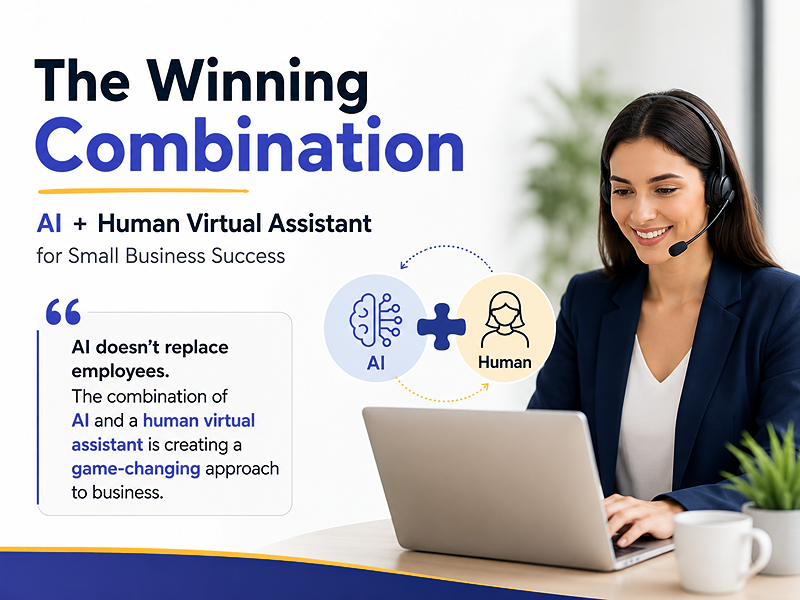
A Virtual Assistant for Small Business is becoming one of the smartest investments for companies looking to improve productivity without increasing overhead costs. As AI continues to transform the way businesses operate, many small business owners are discovering that the greatest results come from combining AI automation with skilled human support.
AI helps automate repetitive tasks, analyze data, and improve efficiency, but successful businesses still rely on human judgment, communication, creativity, and problem-solving. Rather than replacing people, AI works alongside them, helping businesses save time, enhance customer experiences, and focus on sustainable growth.
In this blog, you’ll learn why combining AI with a Virtual Assistant is a winning strategy, how they complement each other, and practical ways this approach can help your business become more efficient and scalable.
Virtual Assistant for Small Business: The Perfect Partner for AI
Many believe AI will replace administrative professionals, but the reality is that AI works best alongside human expertise. While AI automates repetitive tasks, a Virtual Assistant provides the judgment, communication, and personal attention that technology cannot replace.
AI is exceptionally good at:
A Virtual Assistant complements these capabilities by:
Instead of replacing employees, AI allows virtual assistants to spend more time on meaningful work that directly contributes to business growth. This combination creates faster workflows while maintaining the quality and personal service customers expect.
Practical Examples of AI and Virtual Assistant Collaboration
So, what does this partnership look like in everyday business operations? Let’s explore a few practical examples of how AI and a virtual assistant work together to improve efficiency, productivity, and customer experience.
1. Customer Support
AI chatbots can quickly answer common questions, categorize support tickets, and direct customers to the right department, helping businesses respond faster and handle routine inquiries efficiently.
However, when customers have billing concerns, complaints, or unique requests, a Virtual Assistant steps in to understand their needs, communicate with empathy, and provide personalized solutions that AI alone cannot deliver.
By combining AI with human support, businesses can offer faster service, improve customer satisfaction, and build stronger, long-lasting customer relationships.
2. Sales Support
Generating leads is only the first step; consistent follow-up is what turns prospects into customers. AI can capture leads, send automated responses, update CRM records, and schedule initial meetings.
A virtual assistant then qualifies leads, conducts personalized follow-ups, answers inquiries, prepares quotations, and coordinates meetings.
Together, they help businesses respond faster, build stronger customer relationships, and allow business owners to focus on closing more deals and increasing revenue.
3. Social Media Marketing
Maintaining a consistent social media presence is often challenging for small business owners. AI tools can quickly generate blog content, social media captions, recommend keywords, suggest hashtags, summarize articles, and provide content ideas based on current trends.
However, AI-generated content often requires editing before publication.
A virtual assistant can review the content, fact-check information, optimize it for SEO, ensure it aligns with the company’s tone of voice, schedule posts across multiple platforms, and engage with followers by responding to comments and messages.
This combination enables businesses to publish quality content consistently, strengthen audience engagement, while maintaining authenticity and credibility.
4. Administrative Support
Administrative tasks can take valuable time away from growing a business. AI can automate tasks such as appointment scheduling, calendar management, email sorting, invoice reminders, document organization, data entry, and meeting summaries. It can also generate reports and send automated notifications, reducing the time spent on routine administration.
A Virtual Assistant ensures these processes run smoothly by reviewing schedules, coordinating meetings across different time zones, preparing documents, following up on action items, and handling changes or urgent requests that require human judgment.
This combination keeps day-to-day operations organized while giving business owners more time to focus on growth.
5. Bookkeeping and Financial Administration
Managing finances requires accuracy and attention to detail. AI can automate transaction categorization, invoice generation, expense tracking, recurring billing, and financial reporting.
A Virtual Assistant reviews transactions, reconciles accounts, organizes financial records, follows up on unpaid invoices, and coordinates with accountants to ensure accuracy. Together, AI and human oversight help reduce errors and keep financial records reliable.
6. Market Research
Keeping up with market trends and competitors is essential for business growth. AI can quickly gather market data, summarize reports, and analyze customer feedback.
A Virtual Assistant verifies the information, researches competitors, prepares clear reports, and identifies opportunities that support business goals. This combination helps business owners make informed decisions with confidence.
Want to learn how these tasks can be automated? Explore our guide on Automation Workflow: Tasks & Tools You Can Use.
Why Businesses Need Both AI and Human Support
As AI adoption continues to increase, one thing has become clear—technology alone is not enough.
Businesses that combine AI with a Virtual Assistant can gain:
Instead of viewing AI as a replacement for people, successful businesses use it as a tool that enables their teams to work more efficiently.
Common Mistakes Businesses Make When Using AI
AI can improve efficiency, but relying on it without human oversight can create challenges. Common mistakes include:
The most successful businesses use AI to support people, not replace them.
Conclusion
AI is changing the way businesses operate, but its greatest value comes from working alongside people rather than replacing them.
A Virtual Assistant for Small Business brings the human expertise that AI cannot provide; critical thinking, relationship management, problem-solving, and quality assurance. Meanwhile, AI handles repetitive and time-consuming tasks, allowing businesses to work faster and more efficiently.
Together, AI and skilled virtual assistants create a powerful combination that improves productivity, enhances customer experiences, reduces operational costs, and supports sustainable business growth.
For small business owners looking to scale without overwhelming their internal teams, combining business automation with experienced virtual assistant services is a practical and future-ready solution.
Frequently Asked Questions
Can AI replace a Virtual Assistant?
No. AI can automate repetitive tasks, but it cannot replace human judgment, communication, creativity, and personalized support. A Virtual Assistant provides the expertise and oversight that AI alone cannot.
What tasks can AI automate for small businesses?
AI can automate scheduling, email drafting, CRM updates, customer support, data entry, reporting, invoice reminders, and other routine administrative tasks to improve efficiency.
Why combine AI with virtual assistant services?
AI handles repetitive tasks, while virtual assistants provide human oversight, customer communication, quality control, and problem-solving. Together, they help businesses work more efficiently.
Why choose Khened VA Services & Consulting?
We combine AI-enhanced automation with experienced virtual assistants to help small businesses improve efficiency, reduce workload, and grow with confidence.