Businesses that need virtual support often reach a stage where growth begins to create new operational challenges. Expansion is a positive sign, but it also brings more customers, vendors, projects, and responsibilities that require consistent coordination.
At this stage, many companies realize that scaling is not just about increasing revenue. It is also about maintaining service quality, communication, and efficiency while managing heavier workloads.
When day-to-day operations start taking up more time than strategy and growth planning, business performance can begin to slow. If you’re noticing increasing workloads, missed follow-ups, or administrative bottlenecks, explore the signs your business needs a virtual assistant to determine whether additional support could help. This is where virtual assistant services become highly valuable.
Virtual assistants help bridge this operational gap by offering reliable administrative, communication, and process support. This allows businesses to stay organized while continuing to grow without overwhelming internal teams.
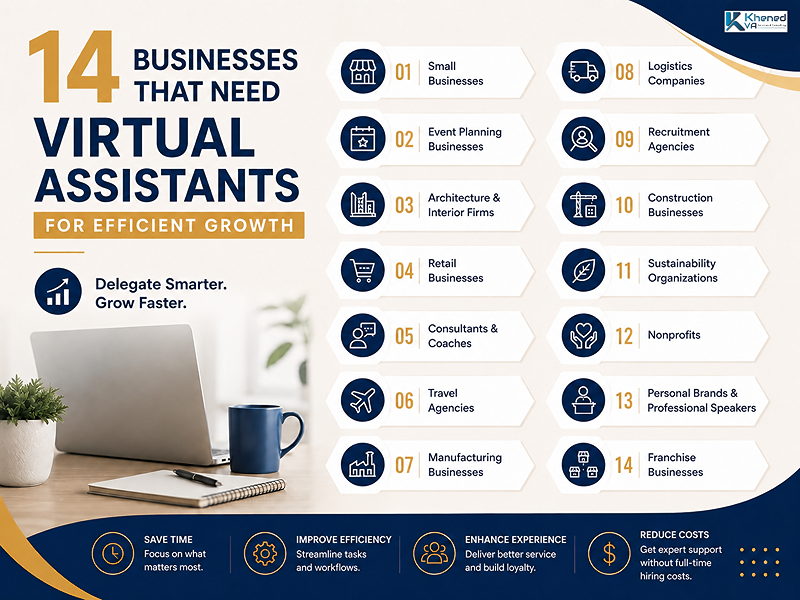
In this guide, we explore 14 types of businesses that benefit from virtual assistant support and the common challenges they face during growth.
Quick Overview of Businesses That Benefit from Virtual Assistants
The table below provides a quick summary of the industries that commonly benefit from virtual assistant support and the challenges they face during growth.
| Business Type | Common Growth Challenge | How a Virtual Assistant Helps |
|---|---|---|
| Small Business Owners | Managing multiple roles | Scheduling, emails, customer support |
| Event Planning Businesses | Handling complex coordination | Vendor follow-ups, guest communication |
| Architecture & Interior Firms | Managing multiple projects | Client communication, project tracking |
| Retail Businesses | Balancing operations & service | Orders, inventory, customer support |
| Consultants & Coaches | Increasing client load | Scheduling, onboarding, follow-ups |
| Travel Agencies | Managing travel details | Itinerary planning, bookings |
| Manufacturing Businesses | Supplier coordination | Documentation, reporting |
| Logistics Companies | Managing deliveries | Tracking, scheduling, coordination |
| Recruitment Agencies | Handling candidate volume | Interview scheduling, database updates |
| Construction Businesses | Multi-site coordination | Vendor tracking, project updates |
| Sustainability Organization | Research & compliance | Reporting, coordination |
| Nonprofits | Limited resources | Donor & volunteer management |
| Franchise Businesses | Audience growth | Content & event coordination |
| Personal brands | Multi-location management | Reporting, communication |
Why Businesses That Need Virtual Assistants Are Growing Rapidly
Growth is exciting, but it often introduces complexity that many teams are not prepared for. As operations expand, communication gaps, delayed responses, and scheduling conflicts can begin to affect efficiency.
Many businesses that need structured operational support start noticing that internal processes become harder to manage as workload increases. Even when revenue grows, productivity can slow if systems are not optimized.
To handle this shift, organizations are increasingly adopting remote administrative support. Virtual assistants help maintain consistency in workflows, improve communication, and reduce the burden on internal teams.
1. Small Businesses Managing Multiple Roles
When everything depends on one person
Small business owners often act as managers, marketers, customer service representatives, and administrators all at once.
As the business grows, managing every responsibility becomes increasingly difficult.
A virtual assistant can help with:
This support helps maintain consistency and ensures important tasks do not fall through the cracks. It also allows owners to focus on growth instead of routine administrative work.
2. Event Planning Businesses Handling Complex Logistics
Every detail matters in events
Event planners require coordinating multiple vendors, venues, clients, and timelines simultaneously.
As bookings increase, managing logistics becomes more challenging.
Support areas
A virtual assistant can assist with:
This helps event planners stay organized while delivering seamless experiences.
3. Architecture and Interior Design Firms Managing Multiple Projects
Managing creativity with structure
Design firms often handle multiple projects with tight deadlines and detailed client expectations.
A virtual assistant can support:
This creates a more structured workflow, improves project visibility, and allows design professionals to stay focused on delivering exceptional results.
4. Retail Businesses Balancing Customers and Operations
Fast-paced retail demands consistency
Retail businesses must manage customers, inventory, and suppliers simultaneously.
Operational support includes:
This ensures smooth operations even during busy periods.
5. Consultants and Coaches Serving More Clients
Scaling expertise comes with admin load
As consultants and coaches attract more clients, administrative responsibilities often increase.
Assistance areas:
This helps maintain a professional client experience as the business expands.
6. Travel Agencies Coordinating Detailed Client Experiences
Precision is key in travel planning
Travel agencies handle multiple bookings, itineraries, and customer preferences simultaneously.
Support tasks:
This helps ensure a smooth experience for travelers while reducing operational pressure.
7. Manufacturing Businesses Managing Suppliers and Documentation
Operations rely on accuracy
Manufacturers deal with suppliers, inventory, and documentation that require constant updates.
Assistance includes:
This improves organization and keeps important information accessible.
8. Transportation and Logistics Businesses Managing Deliveries
Coordination at scale is complex
Logistics businesses handle shipments, drivers, warehouses, and clients simultaneously.
Virtual assistant support:
By handling administrative and coordination tasks, virtual assistants help transportation and logistics businesses maintain smooth operations and improve service reliability.
9. Recruitment and Staffing Agencies Handling Candidate Volume
High-volume hiring needs structure
Recruitment agencies deal with large candidate databases and multiple interviews daily.
Support tasks:
This creates a smoother recruitment process for both candidates and clients.
10. Construction and Contracting Businesses Managing Multiple Job Sites
Multiple sites = multiple challenges
Construction companies manage vendors, schedules, and site updates simultaneously.
Support includes:
This improves coordination across multiple projects.
11. Environmental and Sustainability Businesses Managing Research
Data and compliance require structure
These organizations handle research, reporting, and stakeholder communication.
Assistance:
This helps teams stay focused on environmental initiatives while maintaining operational efficiency.
12. Nonprofit Organizations Working with Limited Resources
Impact with fewer resources
Nonprofits often rely on small teams to manage large responsibilities.
Support areas:
This helps organizations stay organized while maximizing their impact.
13. Professional Speakers and Personal Brands Managing Growth
Visibility brings more responsibility
As audiences grow, managing engagements becomes more complex.
Assistance includes:
This ensures consistent engagement while supporting brand growth.
14. Franchise Businesses Expanding Across Multiple Locations
Consistency across branches is key
Franchise operations require standardized communication and reporting.
Support tasks:
This helps maintain consistency across all locations.
Common Growth Challenges Businesses Face
As companies scale, several operational bottlenecks often appear:
Without proper support systems, these issues can slow down business growth.
How Virtual Assistants Support Business Expansion
Virtual assistants play an important role in helping businesses adapt to growth.
They provide support by:
This allows businesses to operate more efficiently while maintaining service quality.
Many businesses that need scalable operational systems rely on virtual assistants to maintain consistency during growth phases.
Tasks Businesses Often Overlook for Delegation
Many businesses underestimate how much time these tasks consume:
Delegating these improves productivity significantly.
Conclusion
Businesses that need virtual assistants are often experiencing the challenges that come with growth. Whether it is managing customer communication, coordinating projects, handling documentation, or maintaining daily operations, the right support can make a significant difference.
From small business owners and consultants to franchise operators and nonprofit organizations, virtual assistants help businesses manage increasing responsibilities while maintaining organization and efficiency.
As companies continue to grow and adapt, virtual assistant services will remain a valuable solution for businesses seeking flexible support and sustainable operational success.
If your business is spending more time on administrative tasks than strategic growth, it may be time to consider outsourcing routine responsibilities. The right virtual assistant can help streamline operations, improve workflow management, and allow you to focus on what matters most, growing your business and serving your customers.
Looking for reliable virtual assistant support? Khened VA Services & Consulting provides tailored virtual assistant solutions to help businesses improve efficiency, stay organized, and scale with confidence. Contact us today to discover how our team can support your business goals.
Frequently Asked Questions
Businesses experiencing growth, increasing workloads, or operational complexity often benefit the most from virtual assistant services.
Virtual assistants support communication, scheduling, documentation, customer service, and administrative processes, helping businesses manage growth more effectively.
Yes. Small businesses can use virtual assistants to improve organization, maintain customer communication, and manage daily operations more efficiently.
Common tasks include scheduling, email management, customer support, research, reporting, data entry, document organization, and vendor coordination.
No. Businesses of all sizes can benefit from virtual assistant support, especially when operational demands begin to increase.
Businesses are looking for flexible ways to manage workloads, improve efficiency, and maintain consistent operations without increasing internal complexity.